


Vertical studios love to brag about their output.
“We released 47 new shows this quarter.”
“We delivered 1,200 episodes in 60 days.”
“Our pipeline never sleeps.”
And that last part is true.
Because behind the glossy announcements, the paywalled cliffhangers, and the feel-good founder posts… there is an entire global workforce that actually does never sleep.
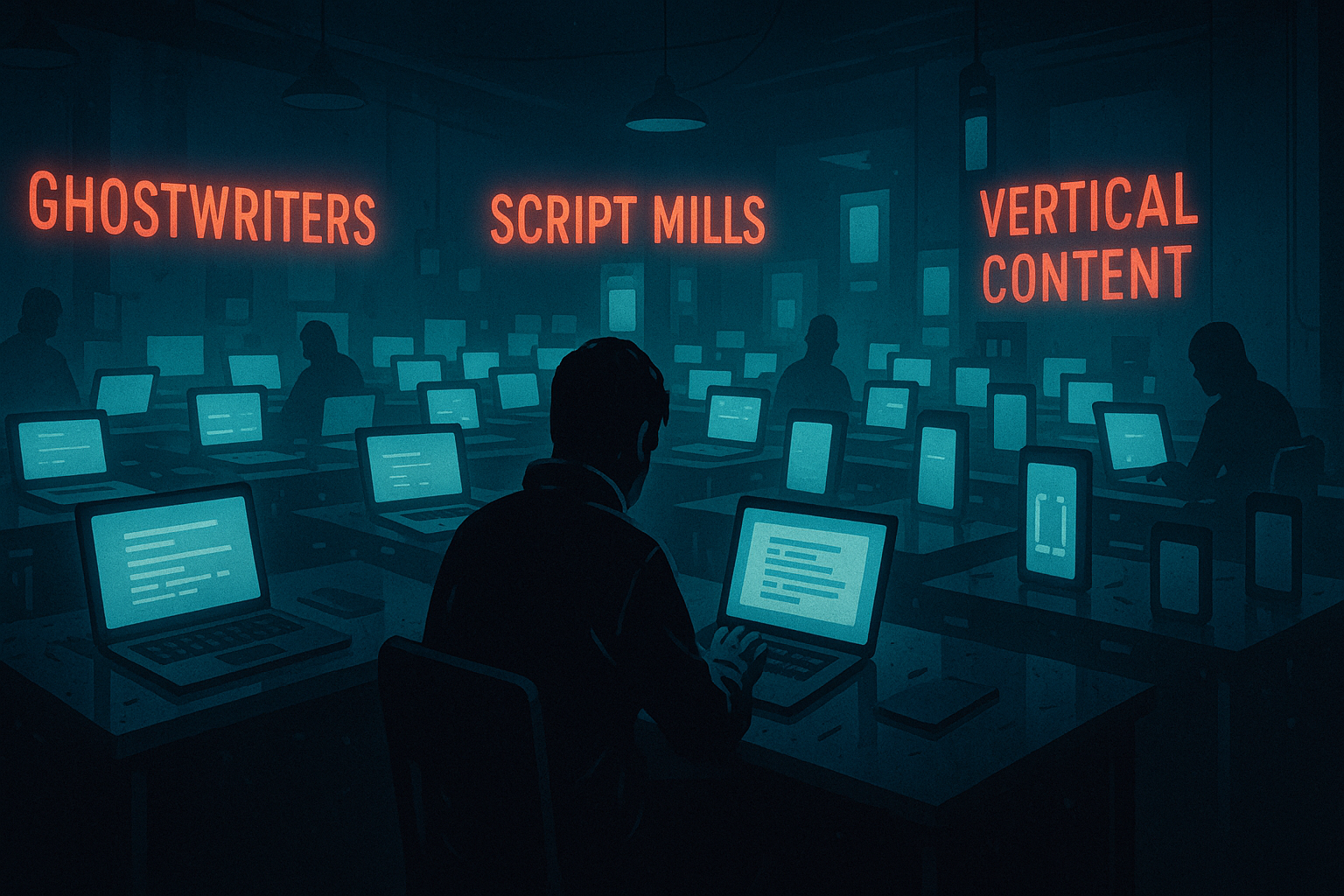
They’re the ghostwriters.
The script mill freelancers.
The offshore content factories churning out 60-episode arcs for the cost of one U.S. staff writer.
The AI-augmented assembly lines generating emotional beats at industrial scale.
And the industry desperately hopes you never notice them.
This is the story of the hidden labor economy holding up the vertical content explosion — and the uncomfortable truth studios don’t want viewers, investors, or creators talking about.
THE NUMBERS DON’T ADD UP — UNLESS SOMEONE ELSE IS PAYING THE COST
On paper, vertical looks like a miracle.
A show shoots for two weeks.
It costs a fraction of a traditional series.
It outputs 50–90 episodes.
It recoups in paywalls and binge cycles.
But the part of the budget that never gets discussed?
The writing.
The math is brutal:
- A 60-episode show requires ~100–140 pages of usable script.
- A studio slate may include 30–40 shows per quarter.
- Even at modest wages, those scripts should cost millions.
Yet the budgets don’t show millions.
The studios don’t pay millions.
And the writers inside the system know exactly why:
Because half the industry runs on invisible labor at bargain-basement rates.
WELCOME TO THE SCRIPT MILLS: FAST, CHEAP, AND RELENTLESS
Talk to anyone who’s been inside a vertical studio — really inside — and you’ll hear the same whisper:
“We get our drafts from overseas.”
The locations vary:
Philippines. India. Pakistan. Nigeria. Eastern Europe.
Wherever English-literate writers are willing to produce high-volume content for $3–$7 per page.
To be clear: these writers are talented and resourceful.
But the pressure? Inhuman.
Writers report:
- turnaround cycles of 24–48 hours
- rewriting 30–60 episodes in a single week
- no credit, no royalties, no visibility
- strict NDAs keeping their existence hidden
- AI-generated outlines they must “humanize” as fast as possible
For many, it’s survival income.
For studios, it’s the secret ingredient that turns small budgets into massive libraries.
The finished product?
Viewed by millions, credited to no one.
THE GHOSTWRITER ECONOMY: YOUR FAVORITE SHOW PROBABLY ISN’T WRITTEN BY WHO YOU THINK IT IS
Every studio has public-facing writers.
They do panels.
They sign contracts.
They lend legitimacy.
But the person who actually wrote Episodes 9–47?
Often a ghost.
Literally.
Ghostwriters describe:
- Being given 3–5 episodes at a time with no context
- Receiving loose beat sheets with contradictory notes from multiple producers
- Having entire arcs changed overnight
- Writing romantic chemistry or plot twists they never see play out
- Delivering 50+ pages for less than the cost of a dinner reservation
And yet the studio’s credited writer remains the same — shielded, protected, and often uninvolved past the initial pitch.
It’s a PR illusion: one “creator,” many uncredited hands.
THE AI PIPELINES: HALF MACHINE, HALF HUMAN, ALL RUSHED
Most vertical studios now run a hybrid pipeline:
- AI generates an outline or scene breakdown.
- Ghostwriters rewrite and humanize it.
- Editors smooth it into a single authorial voice.
- Producers make last-minute changes based on algorithmic predictions.
This system is fast.
Efficient.
Scalable.
But there’s a cost:
- Emotional depth disappears
- Character arcs flatten
- Repetition increases
- Tropes become copy-paste artifacts
- Shows start to feel the same because at a structural level, they are the same
The more AI writes, the more humans scramble to varnish humanity back onto it.
The audience feels the difference — even if they can’t articulate it.
It’s the uncanny valley of vertical storytelling.
THE INDUSTRY IS BUILT ON “GOOD ENOUGH” — AND THAT’S THE PROBLEM
Vertical content has always walked a tightrope:
It must be cheap.
It must be fast.
It must be addictive.
But “cheap and fast” inevitably undermines “addictive.”
When dozens of writers across multiple time zones are patching together arcs like a narrative assembly line, things slip:
- emotional continuity
- character consistency
- plot logic
- world-building
- pacing
- originality
- thematic intention
And yet studios keep pushing volume because volume is what increases paywall opportunities and binge metrics.
But volume has a dark side:
An industry that requires 10,000+ episodes a year will always turn to the cheapest labor available.
THE WRITERS KNOW THE TRUTH — AND THEY’RE STARTING TO TALK
In private channels, ghostwriters trade stories:
- “I wrote an entire season and the studio never told me if it aired.”
- “I got replaced by an AI outline last month.”
- “I was told to change the twist because another show already used it last week.”
- “My pay dropped 40% after they introduced their new AI tool.”
- “They warned me not to talk publicly — or I’d lose the work.”
These are not isolated incidents.
They’re systemic.
And as vertical grows, the pressure grows with it.
The industry is expanding, but the people writing the stories remain invisible — and shockingly underpaid.
THE AUDIENCE DOESN’T KNOW. THE INVESTORS DON’T ASK. THE STUDIOS DON’T TELL.
Vertical’s public narrative is clean:
- bold new creators
- fresh storytelling
- creator-first platforms
- global reach
- endless opportunity
But the private narrative is messier, more fragile, and much more dependent on global labor than anyone admits.
Ask investors how many full-time writers their favorite studio employs.
Most will say dozens.
The truth?
“Dozens” often means two in-house creatives, and 200 invisible contractors working in the dark.
THE FUTURE: RECKONING OR REFORMATION?
The vertical industry sits at a crossroads.
Option 1: Keep pretending everything is fine.
Ghostwriters will keep writing.
Script mills will keep producing.
AI will keep expanding.
Quality will keep drifting downward.
Audience fatigue will keep rising.
The bubble will eventually burst.
Option 2: Build a real writing economy.
Pay writers like professionals.
Credit them.
Train them.
Retain them.
Stop treating scripts as disposable content.
Stop worshiping volume over value.
The studios that address this first will become the true industry leaders — not through press releases, but through long-term sustainability.
THE BOTTOM LINE
Vertical storytelling is built on ambition, innovation, and possibility.
But it’s also built on unseen labor, undervalued writers, and a hyper-efficient pipeline that strips humans of authorship while demanding human emotion.
The industry can keep hiding its shadow writers.
Or it can finally acknowledge them — and build a future worthy of their work.